

12.2. 依概率收敛#
我们举一个例子,可以直观感受一下随机变量序列是可以收敛的。
Example 12.1
在抛一枚均匀硬币(正面反面出现的概率相等)的场景下,令随机变量 \(X_i\) 表示 \(i\) 枚硬币正面朝上的频率。考虑一次实验的数据,如表 Table 12.1 。
第 \(i\) 次抛硬币 |
1 |
2 |
3 |
4 |
5 |
6 |
7 |
8 |
9 |
10 |
|---|---|---|---|---|---|---|---|---|---|---|
结果 |
反面 |
反面 |
正面 |
正面 |
反面 |
正面 |
正面 |
正面 |
反面 |
反面 |
于是,根据抛硬币的结果,随机变量序列 \(\{X_i\}\) 的取值为 \(x_i\) ,见表 Table 12.2
\(x_i\) |
1 |
2 |
3 |
4 |
5 |
6 |
7 |
8 |
9 |
10 |
|---|---|---|---|---|---|---|---|---|---|---|
取值 |
\(0\) |
\(0\) |
\(0.33\) |
\(0.50\) |
\(0.40\) |
\(0.50\) |
\(0.57\) |
\(0.63\) |
\(0.56\) |
\(0.50\) |
根据表 Table 12.2 ,我们可以将 \(\{X_i\}\) 绘制在一张图中,如图 Fig. 12.1 。
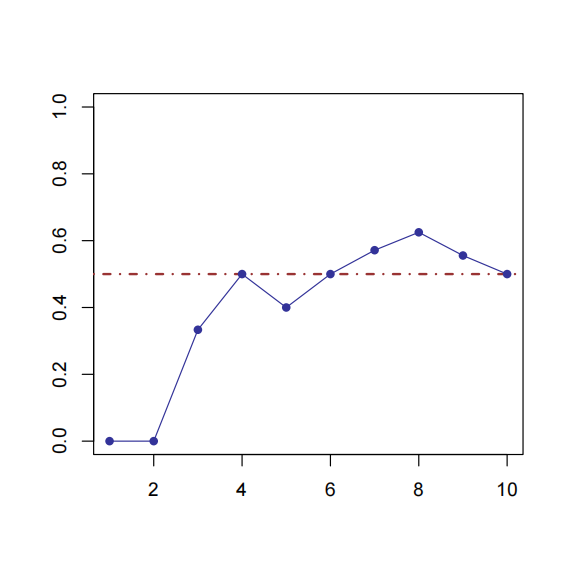
Fig. 12.1 抛 10 枚硬币的结果#
类似地,我们分别抛 30、60、90 以及 120 次硬币后的结果,如图 Fig. 12.2 所示。
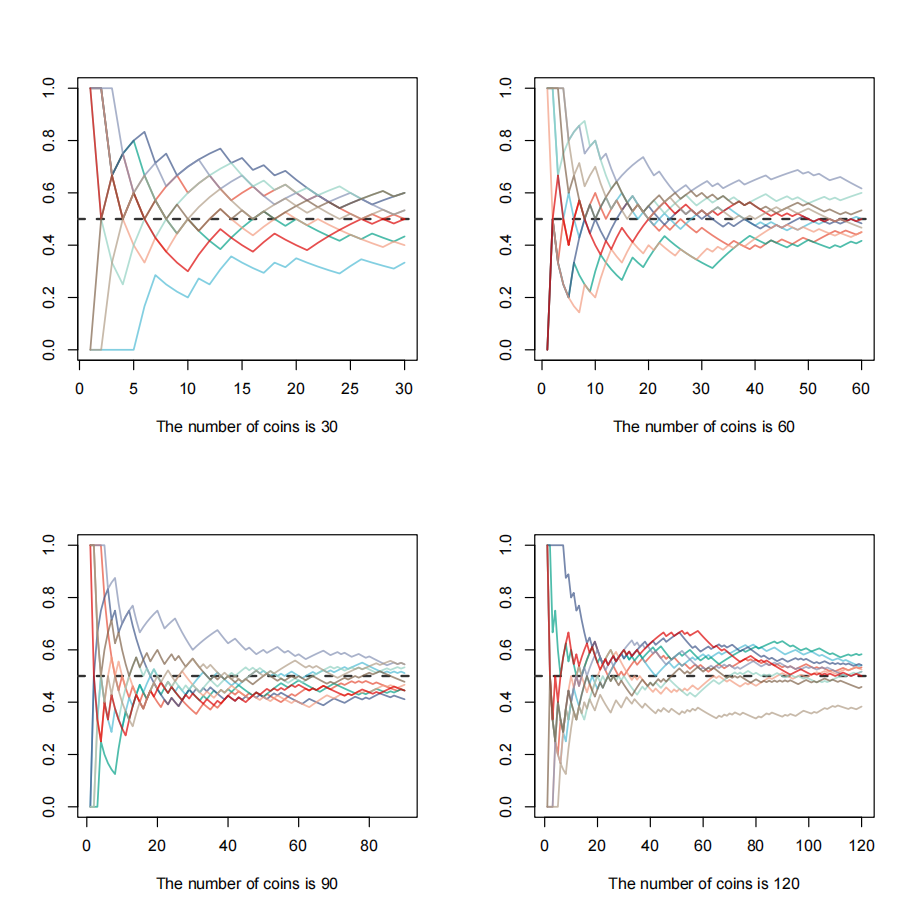
Fig. 12.2 多次抛硬币的结果#
import numpy as np
import matplotlib.pyplot as plt


def prompt_positive_float(message: str) -> float:
    """Request a positive numeric value from stdin."""
    while True:
        try:
            value = float(input(message))
        except ValueError:
            print("Please enter a valid number.")
            continue
        if value <= 0:
            print("Value must be greater than zero.")
            continue
        return value


def read_parameters():
    print("Buffon's Needle Simulation (9 throws)")
    while True:
        l = prompt_positive_float("针的长度 l (比如5): ")
        d = prompt_positive_float("线的空间 d (最好大于线长度哦,比如8): ")
        if l >= d:
            print("Constraint violated: l must be smaller than d. Try again.\n")
            continue
        return l, d


def simulate_and_plot(l: float, d: float) -> None:
    x_min = 0.0
    x_max = d * 3
    y_min = -l
    y_max = l + d
    fig, axes = plt.subplots(3, 3, figsize=(15, 12))
    axes = axes.flatten()
    cross_count = 0

    for idx, ax in enumerate(axes, start=1):
        phi = np.random.uniform(0, np.pi)
        x_center = np.random.uniform(d, d * 2)
        y_center = np.random.uniform(0, d)

        half_len = l / 2
        x1 = x_center - half_len * np.cos(phi)
        y1 = y_center - half_len * np.sin(phi)
        x2 = x_center + half_len * np.cos(phi)
        y2 = y_center + half_len * np.sin(phi)

        hit = False
        for j in range(4):
            if min(y1, y2) <= j * d <= max(y1, y2):
                hit = True
                cross_count += 1
                break

        ax.set_title(f"Trial {idx}")
        ax.set_xlim(x_min, x_max)
        ax.set_ylim(y_min, y_max)
        ax.set_aspect("equal")
        ax.axis("on")

        for j in range(4):
            ax.axhline(y=j * d, color="black", linestyle="-", linewidth=1)

        color = "red" if hit else "blue"
        ax.plot([x1, x2], [y1, y2], color, linewidth=2)
        ax.plot(x_center, y_center, "bo", markersize=5)

        arc_radius = l / 4
        arc_angles = np.linspace(0, phi, 100)
        arc_x = x_center + arc_radius * np.cos(arc_angles)
        arc_y = y_center + arc_radius * np.sin(arc_angles)
        ax.plot(arc_x, arc_y, "g-", linewidth=1)
        ax.text(x_center + arc_radius * 1.1,
                y_center + arc_radius * 0.3,
                r"$\phi$",
                fontsize=12)

        status_y = y_min + 0.1 * (y_max - y_min)
        ax.text(x_min + 0.1 * (x_max - x_min),
                status_y,
                f"Status: {'hit' if hit else 'miss'}",
                fontsize=10,
                bbox=dict(facecolor="white", alpha=0.8))

    plt.tight_layout()
    plt.show()

    theoretical_probability = (2 * l) / (np.pi * d)
    empirical_ratio = cross_count / 9
    print(f"Theoretical probability P = {theoretical_probability:.4f}")
    print(f"Empirical hit ratio = {empirical_ratio:.4f} ({cross_count}/9)")
def main():
    l, d = read_parameters()
    simulate_and_plot(l, d)


if __name__ == "__main__":
    main()
请思考一下以下两个问题:
Question
从你运行的实验中,你发现了什么相似点?
这些相似的结果是否普遍存在的?
Conclusion
概率是频率的稳定值;
频率 \(X_n\) 与概率 \(p\) 的绝对偏差 \(\left|x_{n}-p\right|\) 将随 \(n\) 增大而呈现主键减小的趋势;
由于随机性,绝对偏差 \(\left|x_{n}-p\right|\) 时大时小,虽然无法排除大偏差发生的可能性,但岁 \(n\) 不断增大,大偏差发生的可能性会越来越小。
由此,我们定义随机变量序列的一种收敛性。
- 收敛性
设 \(\{X_n\}\) 为一随机变量序列,而 \(X\) 为一随机变量。如果对任意的 \(\varepsilon>0\) ,有
则称序列 \(\{X_n\}\) 依概率收敛于 \(X\) ,记作 \(X_{n} \stackrel{P}{\longrightarrow} X\) 。
Remark
在定义中 \(P\left(\left|X_{n}-X\right| \geqslant \varepsilon\right) \rightarrow 0\) ,等价于 \(P\left(\left|X_{n}-X\right|<\varepsilon\right) \rightarrow 1\) ;
特别地, \(P(X=c)=1\) 时, 则 \(X_{n}\stackrel{P}{\longrightarrow} c\) 。
Property 12.1 (依概率收敛的四则运算)
设 \(\{X_n\}, \{Y_n\}\) 是两个随机变量序列, \(a,b\) 是两个常数。如果
则有
\(X_{n} \pm Y_{n} \stackrel{P}{\rightarrow} a \pm b\) ;
\(X_{n} \times Y_{n} \stackrel{P}{\rightarrow} a \times b\) ;
\(X_{n} / Y_{n} \stackrel{P}{\rightarrow} a / b, b \neq 0\) 。
Example 12.2
设随机变量 \(X_n\) 服从柯西分布,其密度函数为
试证 \(X_{n} \stackrel{P}{\rightarrow} 0\) 。
Proof
我们考虑事件 \(\{|X_n - 0|\geq \varepsilon\}\) 发生的概率,即
Question
比较一下,数列的收敛性与随机变量的收敛性。
Question
如果 \(X_{n} \stackrel{P}{\rightarrow} a\) ,那么 \(E\left(X_{n}\right) \rightarrow a\) 成立吗?
接下来我们看下面一个例子。
Example 12.3
考虑一个随机变量,其分布列为
Solution
由题可知,
因此, \(X_{n} \stackrel{P}{\rightarrow} 0\) 。我们来计算一下 \(X_n\) 的数学期望,即
因此, \(E\left(X_{n}\right) \rightarrow 0\) 。